
Stepping Out of My Comfort Zone
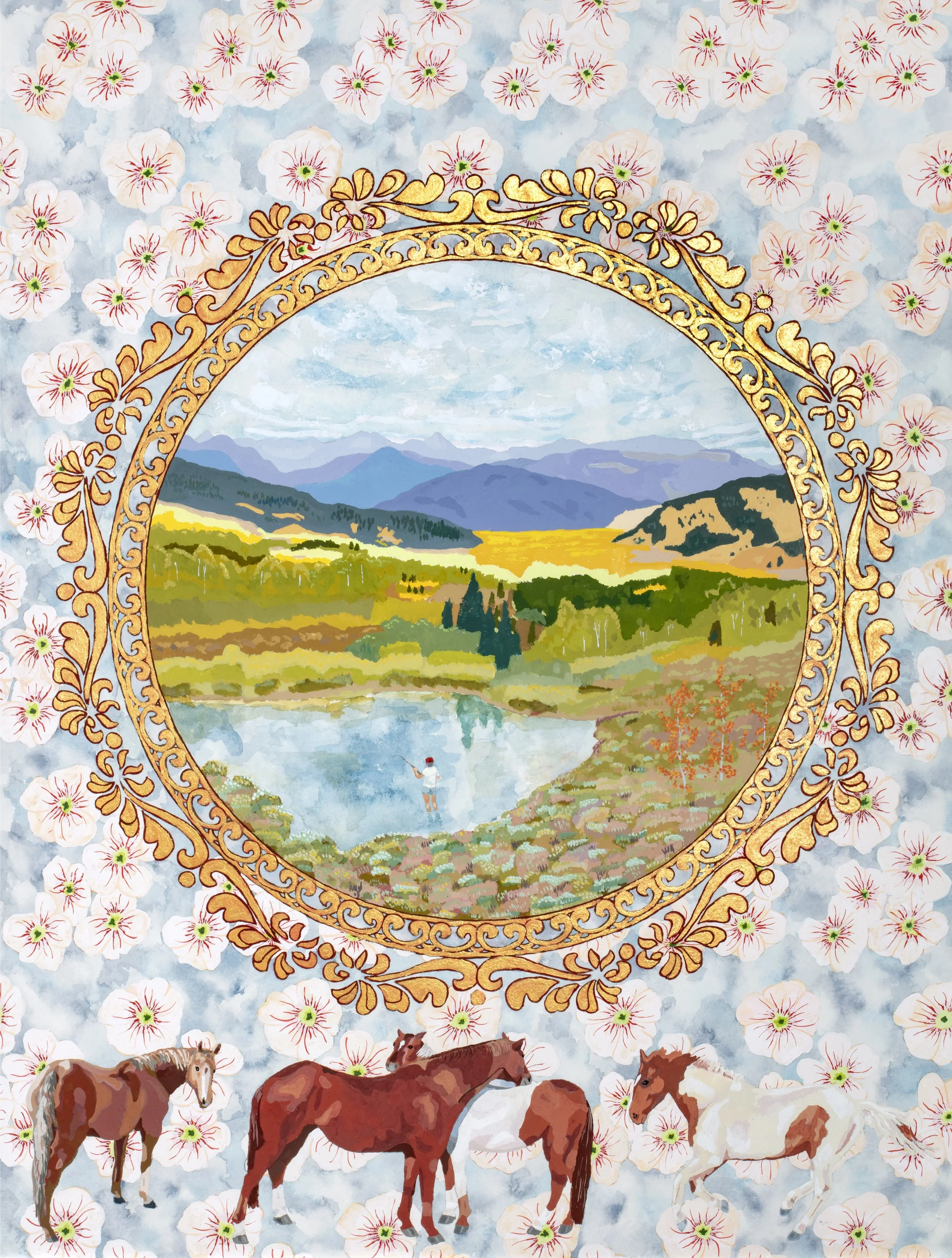
Dude-Ranch Commission, 30" x 22", gouache on paper, 2025.
There is something that happens to a painter who’s been out of art school for a long time. You get to a place in your work that is like throwing on a comfy pair of jeans every morning. It’s not that you’re not working hard, or taking yourself seriously, because you are, and you do. But you don’t need to put on the painter’s uniform to know you’re one. In fact, you don’t ever question it anymore, because the artist identity is your skin; it’s unquestionably part of you.
A mature painter is also not surrounded by the constant judging opinions of professors and classmates. You don’t sit through grueling crits feeling exposed and misunderstood, crits which often elicit a feeling of imposter syndrome. In art school, it’s hard not to become influenced by the myriad of voices you’re exposed to when you're at such a vulnerable point in your artistic growth curve. It’s a relief when that awkward growth spurt is behind you, and you are left in the peace and quiet of your own mind/studio.
There's a lot to be said for this post-graduate studio situation. Most artists don’t hit their stride until they’re well out of school, and the ones who becomes immediately successful often get locked into an artistic hell of having to churn out the same kind of work for years—maybe decades— because of market demand for their “style”.
Being relatively un-famous has great perks: you can make the work that you’re inspired to make, and you can take as long as you need, to find your voice. Also, you are finally free to cultivate your obsessions without anyone looking over your shoulder, like a gardener tending to their own unique, eccentric garden in blissful solitude.
But artists (or at least painters) are both showmen and hermits: we need solitude to create, and yet we crave the appreciation of our audience. We might deny that we’re ever aware of this audience. We may claim that the work comes from divine inspiration. We think we are just the vehicle needed for the work to be born, like a surrogate mother carrying the seed of a masterpiece. (I hope you hear the sarcasm here!) But I think deep down we all know we want to communicate with the viewer. Artists are creators first, but we are communicators too.
For me, being a “mature” artist is quite liberating! Like donning the old jeans, my studio practice is comfortable: the work looks and smells like mine, and I can basically just follow the siren call of my own internal muse, making whatever strange and sometimes foreign paintings come out of me.
But what happens during a commission? This rewarding process introduces a new voice into the dialogue between me and the painting, making it much more challenging. Now, I not only listen to my own muse… I also listen to another person’s muse, as filtered through what they tell me, and what I gather from our conversations. And this can be both very fun, and sometimes, a little unnerving. I’m not just wearing my old jeans in the studio anymore. I’m also wearing something that belongs to someone else, a sensibility that holds their shape, which is always different from mine. I want my new audience to love the painting, but I also need to love it on my own terms, and that can be a juggle.
This spring, a friend and a very loyal client asked me if I would be interested in doing a landscape commission. I had to think about it, because I haven’t painted a landscape in almost thirty years. I’m not a landscape painter, I’m a pattern painter, and I couldn’t imagine how this painting would look. So I explained my reservations to the friend, saying I would do it, but I wouldn’t charge him if it he wasn’t satisfied with it.
He sent me a bunch of digital images he had made from old slides, which gave me a feel for the place he wanted depicted. But the slides were too dark and grainy, and didn’t have enough information in them. The location was a dude ranch in Wyoming, a place where his family had gone several times on vacation, clearly a sentimental memory. One photo of his mom fishing struck me; I liked her stance and the nostalgic quality of it. Another photo had two horses nuzzling each other’s backs, and I thought I could use it, even though the light was terrible. But none of the others would work.
I sketched, and contemplated; and contemplated more, and sketched. I spent hours on Google, looking for interesting pictures, following links and searching for photographs on Instagram. I procrastinated and worked on one of my own paintings, and finished that one. After a few months, I found a few good high resolution images, but I still couldn’t get excited for this painting. I had to admit it, I was totally stuck. I thought seriously of telling my friend I couldn’t do it because it was too far outside my comfort zone… but something in me didn’t want to give up.
Then one day, while I was out walking alone with my puppy, I started to query myself. What was my hang up about this piece? By now, I had the reference images I thought I could use, but I just couldn’t connect to anything. So I started to think about the canvas, or in my case the paper: visualizing every square inch of the landscape. When I got to the edges of the paper, I realized that was the hang up! I didn’t like how the landscape continued off the paper indefinitely, by connecting with its edges. It wasn’t contained. And in the next moment of insight, I realized that if I could “frame” the landscape, I could connect with the idea. My mandala paintings always frame an image inside the circle, and I could use the same device. THAT was the entry point-- all I needed to start the commission.
Ultimately, I ended up including the horses below the landscape, which might seem like an odd choice, because I could have put them within it. I wanted to use some different painting styles within the piece though, so keeping the horses outside, romping beneath the frame made more sense to me. Painting the landscape itself was challenging too… because 30 years ago, my landscapes were fauvist style-- very distorted and colorful. But I wanted this landscape to be more pastoral and nostalgic, like a painting you might see in an old Victorian house, sitting on a wall of wallpaper. I thought about this piece as a painting within a painting, and that shift tickled something in my brain, sparking an interest that has carried beyond that commission and into my own studio work.
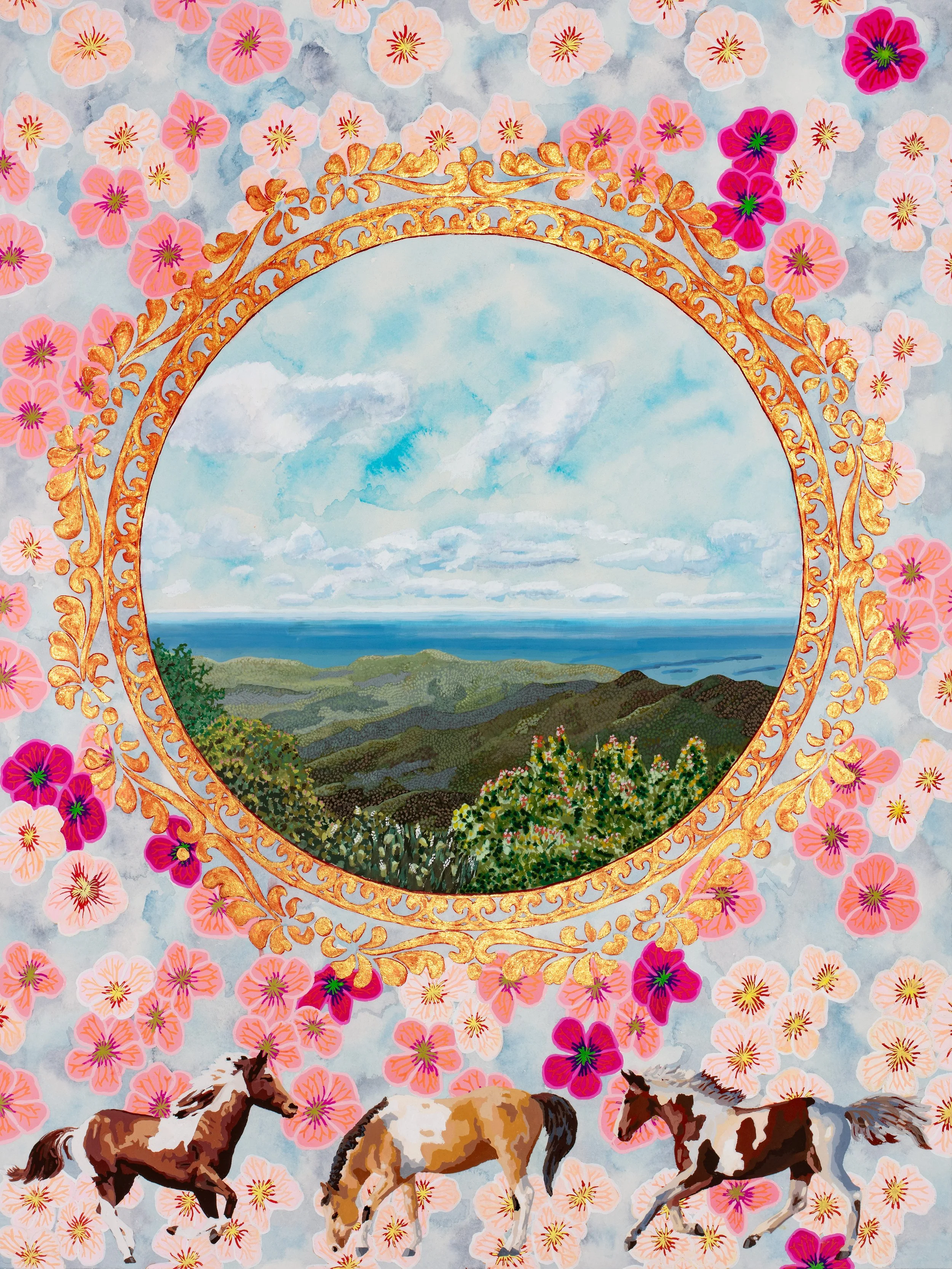
"My Favorite Escapes" 30" x 22", gouache on paper, 2025.
So, I did a second landscape! This one depicts one of my own favorite places (a mountain my daughter and I climbed in Curaçao) and a pony I owned when I was young. Chipster was a paint horse (a beautiful breed) and a very important companion to me. I painted two other paint horses with him that I compiled out of various images I found. I love the juxtapositions of the horses and the landscape against the wallpaper pattern. This theme has opened up a whole new world of possibilities for future paintings!
The landscape commission forced me out of my artistic comfort zone, similar to the way various assignments in art school pushed me to contemplate unfamiliar subjects or materials. This is a very important thing to do every so often in studio practice. I don’t think my work would’ve taken this turn if it hasn’t been for the commission, so I’m really glad that it all happened this way. Bringing in my friend’s ideas reminded me of how important it is to occasionally step outside of our comfort zones and try something that feels weird and different. And I do believe that this applies to life in general. We grow so much by stretching ourselves, and trying new and possibly scary things!
I'm enjoying my creative practice immensely these days, splitting my time between writing and painting. I'm now in the middle of my fourth landscape, and rather than seeing this theme coming to an end, each painting seems to lead to the next. I can’t wait to see where these go, and that feels exciting! 😊